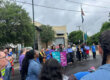

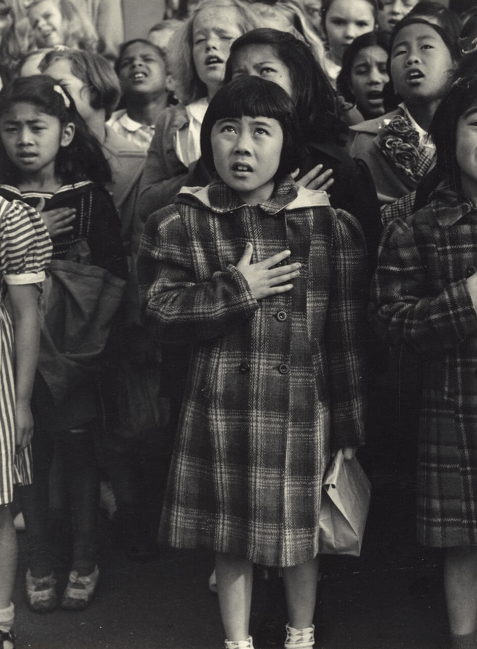
CHILDREN OF THE WEILL PUBLIC SCHOOL SHOWN IN A FLAG PLEDGE CEREMONY
Dorothea Lange, April 1942, printed c. 1965, gelatin silver print, Gift of Daniel Greenberg and Susan Steinhauser, 2016.191.17
After the Japanese bombing of Pearl Harbor in 1941, the US government imprisoned more than 100,000 Japanese Americans living on the West Coast in internment camps. More than half of these people were US citizens, and many of them were children. Dorothea Lange was hired by the War Relocation Authority to document the incarceration process. She photographed a group of public school children reciting the Pledge of Allegiance to the American flag in 1942 in San Francisco, California, as the roundup efforts began. It’s likely some of these children were sent to internment camps.
THE STEERAGE
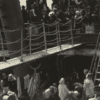
Alfred Stieglitz, 1907, printed 1929/1932, gelatin silver print, Alfred Stieglitz Collection, 1949.3.291
Alfred Stieglitz was traveling on a ship from the United States to Bremen, Germany, when he photographed the area known as steerage, the lower deck of the ship that housed passengers who paid the cheapest fare.
Such passengers, including many early 20th-century migrants to the United States, often experienced overcrowding, lack of ventilation, and minimal food and water during their multiple-day trips.
A SHIP NAMED ‘DIASPORA’
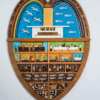
Mike McDonnell, 2007
In Mike McDonnell’s A Ship Named ‘Diaspora’ (2007), beneath a seemingly harmonious, or at least blissfully ignorant façade, the amiably cartoonish passengers reveal an uncomfortable reality. They journey together in the heart-shaped confines, but as the levels of the ship descend it becomes clear that passengers are divided based on privilege that reveals itself in race, religion, and class. McDonnell depicts a scathing commentary on how outwardly multicultural societies continue to insidiously practice segregation.
TOMORROW I MAY BE FAR AWAY
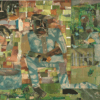
Romare Bearden, Tomorrow I May Be Far Away, 1967, collage of various papers with charcoal, graphite and paint on paper mounted to canvas, Paul Mellon Fund, 2001.72.1
Romare Bearden was one of more than 6 million African Americans who fled the US South between 1916 and 1970 for points north and west during the Great Migration. He and his parents left North Carolina for Harlem, the epicenter of black arts and culture in New York City, where Bearden grew up surrounded by poets, writers, and musicians. He also regularly visited relatives in Pittsburgh and North Carolina. The Great Migration was one of the largest internal mass migrations in world history. African Americans left behind Jim Crow laws and other forms of oppression in the South for the chance at a better life.