

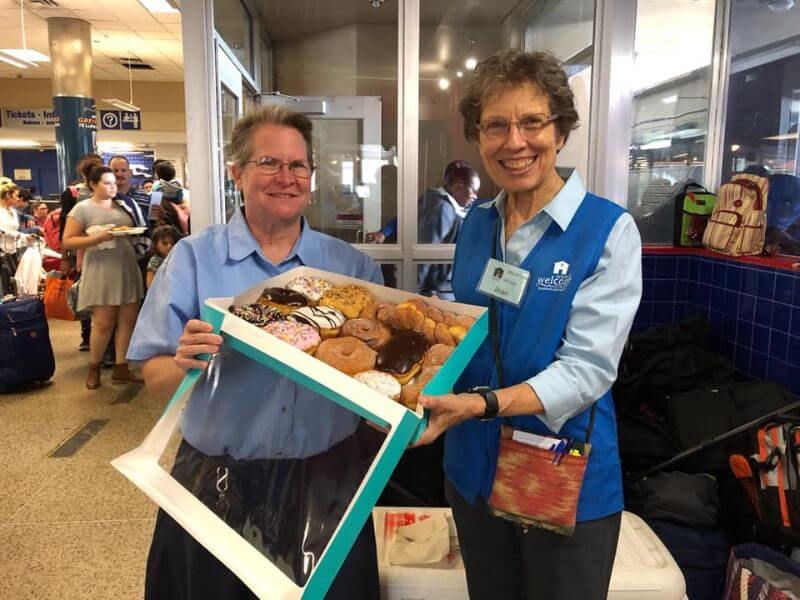
Sr. Denise LaRock and Sr. Jean Durel offer a favorite treat to asylum-seeking families at the Greyhound station.
IWC began in 2014 and functioned as an all-volunteer organization for six years. In 2015, it was able to distribute 2,500 backpacks to 2,500 families. In 2019, it distributed 25,000! Creating and distributing the backpacks, along with greeting and assisting the families, joining in or hosting rallies, and collaborating with other groups was accomplished by an ever-growing corps of volunteers.
The spring through fall of 2019, saw a major surge in people seeking asylum, not just from Central America but also from Haiti, Cuba, several African nations, and other distressed countries. Sr. Denise LaRock was sent here by her order to serve full-time with IWC. She became its key spokesperson and director of “whatever-was-going-on” in the effort to assist the migrants.
Travis Park Church, the City of San Antonio, Catholic Charities, and others all dived in to help, each adding new roles to their regular duties. Faith Communities and other organizations developed teams to assist the hundreds of migrant families sheltered nightly at Travis Park Church. The City opened a Migrant Resource Center near the bus station directed by the newly created Immigration Liaison, Tino Gallego. Once again, donors and volunteers answered the call, and IWC made it through that summer “in collaboration with others,” as its mission statement calls us to do.
IWC survived on smaller grants and assistance, mostly from national denominations or Catholic religious orders that didn’t require official federal tax-exempt nonprofit status [also called 501(c)(3) status]. In addition, it had some very generous private donors.
In 2020, Sr. Denise La Rock was called away to another service by her order. With so much to juggle, IWC’s leadership council began to consider whether IWC might need to become an official 501(c)(3). The issue had come up before, and IWC’s lawyer had advised against it, noting that it would change the organization in ways the leadership council could not imagine and was not prepared to deal with.
But dealing with increasing numbers of asylum seekers required more funding than IWC could generate. It would need to apply for more and larger grants for which only 501(c)(3) organizations were eligible. There was one more thing that tipped the scales: IWC volunteers always transported people in their own cars. Liability had been a concern, and other ways of handling it (such as Lyft) were not complete solutions. IWC needed to be able to provide liability insurance for the volunteers.
Now, with so much going on, it was critical to address it head-on. It was clear, the time to make the transition to a 501(c)(3) status was upon us.
Next Issue: Building Our Staff